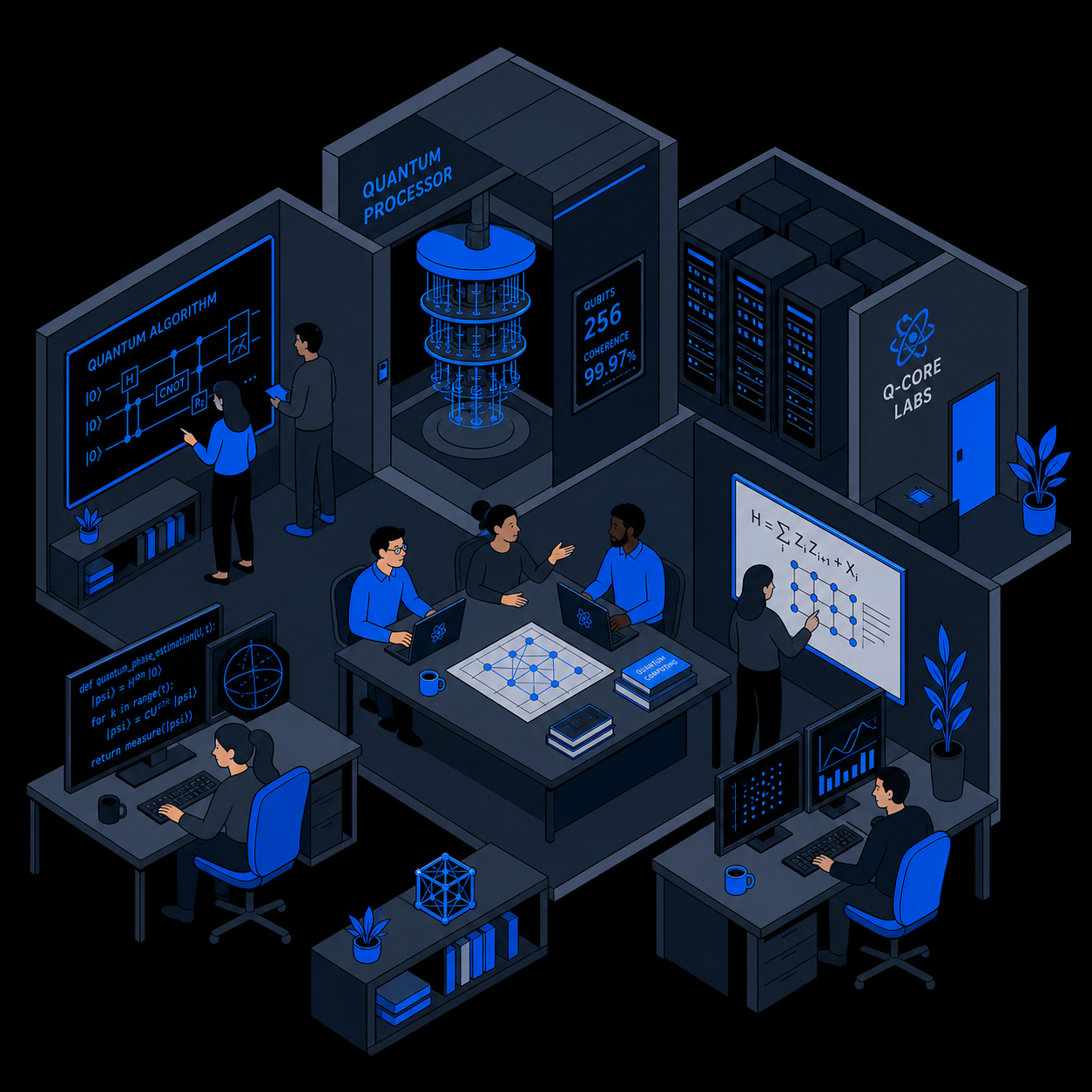
How to Organize a Quantum Working Group Inside a Large Company
Most enterprises treat quantum computing like a weather forecast. They watch the headlines, acknowledge the potential for disruption, and hope it stays on the horizon for a few more years. This passive approach is a liability. While true fault-tolerant systems remain a laboratory pursuit, the winners of the next decade are the teams building internal algorithmic competence today. If you are waiting for a commercially viable "Q-Day" to initiate your quantum strategy, you have already missed the window to develop the institutional knowledge required to leverage these machines when they arrive.
Why does a "top-down" mandate often fail?
You cannot simply hire a team of PhDs, isolate them in a basement, and expect a business ROI. Quantum projects often fail because they lack a translation layer between fundamental physics and operational business problems. A successful working group must be a bridge, not a silo. It requires a balanced composition of your existing domain experts, people who understand your current supply chain, risk modeling, or materials simulation and a lean team of quantum-literate software engineers. The goal is not to perform academic research. The goal is to map your most persistent computational bottlenecks to quantum-ready frameworks for commercialization.
Who should sit at the table?
Your core team needs a tightly integrated triad. A lead Quantum Algorithm Scientist is required to define the mathematical approach and circuit construction. A senior Data Scientist must oversee classical data preprocessing and the integration of hybrid classical-quantum outputs. Finally, a Domain Expert from your specific business unit must anchor every project in commercial reality. This cross-pollination prevents the team from drifting into purely theoretical work that lacks any real-world application.
What does the "Experimental Utility" phase actually look like?
We are currently in an era of Experimental Utility. The hardware is noisy and limited in qubit count, but it is entirely sufficient for benchmarking hybrid workflows. During this phase, your working group should prioritize three specific operational pillars:
- Algorithmic Mapping: You must focus on translating QUBO or VQE problems into actionable quantum circuits. Success is defined by the number of high-value business cases successfully mapped and tested.
- Hybrid Integration: Your team needs to focus on connecting classical data pipelines to quantum backends. Success is measured by reducing latency between classical preprocessing and quantum execution.
- Platform Literacy: Evaluate hardware and software backends constantly. Success is defined by the team's ability to switch seamlessly between IBM, IonQ, or high-performance simulators as the market shifts.
What is the structural blueprint for your team?
Start small, but start with a charter. Your internal group should own the "quantum stack" integration, ensuring that your data scientists can run experiments without needing a degree in condensed matter physics.
- Define the Business Constraints: Identify where classical compute hits a wall. Is it the combinatorial explosion of your logistics network? Is it the precision required for chemical simulations?
- Establish a Hardware-Agnostic Workflow: Do not bet your roadmap on a single vendor. Your stack must be modular enough to toggle between superconducting, trapped-ion, or photonic processors as they mature.
- Formalize the "Data-to-Deployment" Cycle: Treat quantum experiments like software releases. You need version control for your circuits, automated testing for your hybrid algorithms, and clear documentation on why a specific optimizer was chosen.
This is where Bloq Quantum becomes the essential infrastructure. We provide the ecosystem that abstracts away the hardware complexity, allowing your team to move from abstract "quantum readiness" to actual business-case testing. By leveraging our unified environment, your working group can focus on what matters: building the algorithmic frameworks that will eventually replace your most expensive classical compute processes.
Frequently Asked Questions
How do we measure ROI during the experimental phase?
ROI in the pre-utility phase is measured by "time-to-insight" and the reduction in development friction for your technical staff. You are investing in institutional fluency, not immediate operational replacement.
Should we build our own internal quantum hardware?
No. Enterprises should focus on software and algorithmic IP, leaving the highly specialized, capital-intensive work of hardware development to the current ecosystem of specialized providers found in resources like The Quantum Insider.
What is the most common mistake in forming a quantum group?
The most common mistake is failing to integrate the group into existing business units, resulting in "science projects" that never address a real, revenue-impacting technical debt.
How do we handle hardware agnosticism effectively?
You handle it by adopting a middleware platform that sits above the hardware layer, allowing you to recompile your algorithms for different backends without rewriting your core logic. For deeper insights on industry standards, consult the NIST quantum documentation.