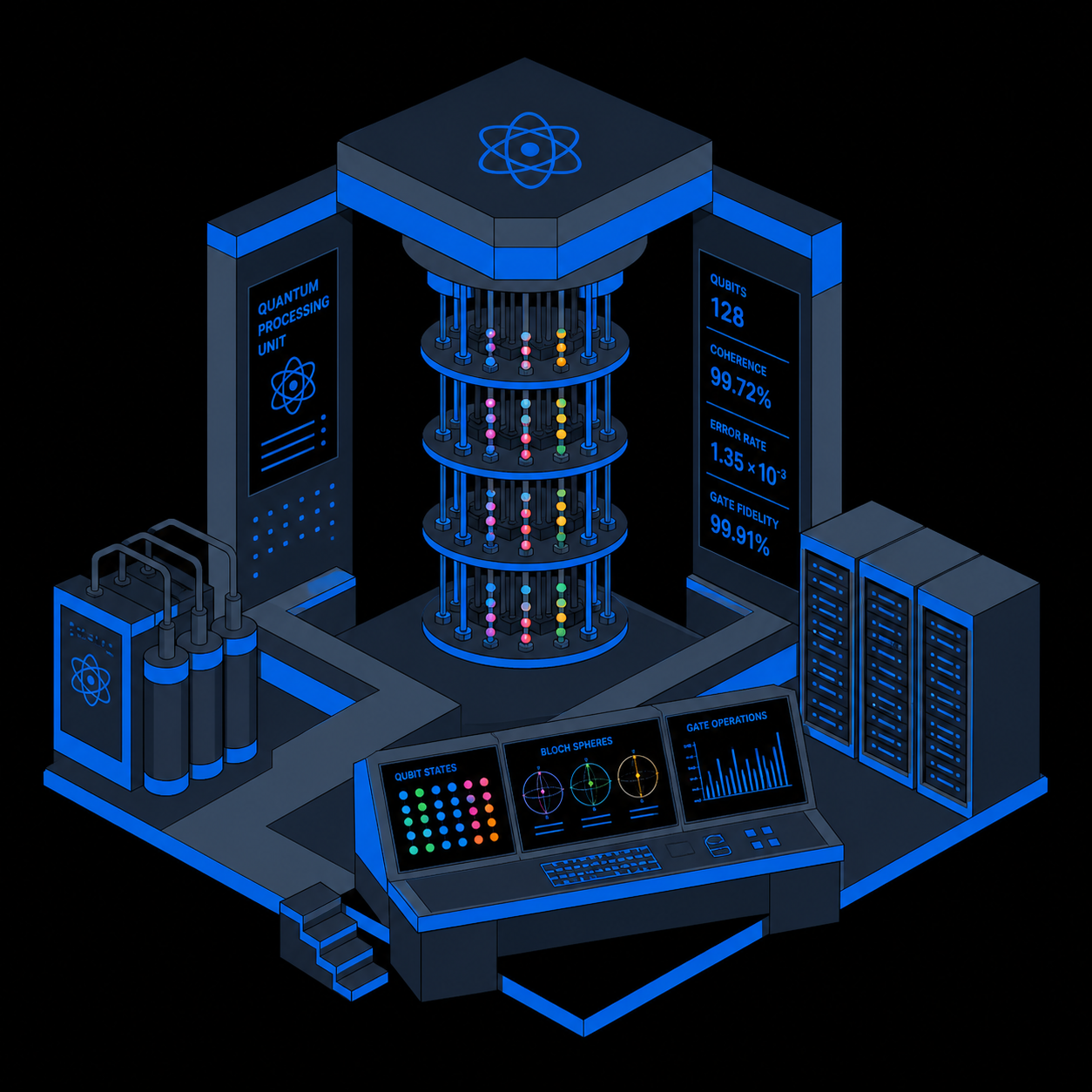
Decoding QPU Metrics: An Enterprise Guide to Evaluating Quantum Hardware
If your quantum hardware evaluation process relies entirely on comparing the raw number of qubits listed on a vendor’s datasheet, you are likely misallocating your R&D capital. The hardware market is heavily fragmented. Competing vendors use entirely different architectures and marketing terms to describe performance, making apple-to-apples comparisons difficult for technical leadership.
We live in an era of experimental utility. True fault-tolerant quantum production remains a laboratory milestone, meaning the near-term competitive advantage does not belong to the enterprise that waits for a perfect machine. It belongs to the organization that builds resilient algorithmic frameworks today. To do that, your technical leadership must look past the marketing headlines and evaluate Quantum Processing Units (QPUs) using rigorous, objective metrics.
Why counting physical qubits is an enterprise vanity metric
A physical qubit is a single quantum structure. It could be a superconducting loop, an isolated ion, or a neutral atom. By itself, a high physical qubit count tells you very little about performance. If a processor has 1,000 physical qubits but a high error rate, those qubits cannot coordinate long enough to complete a calculation.
Enterprise leaders must focus on algorithmic qubits (AQ) or logical qubits instead. Algorithmic qubits represent the number of usable, high-functioning qubits available for real-world application circuits after accounting for error mitigation and hardware constraints. A system with 35 stable algorithmic qubits can often execute more valuable optimizations than a system boasting hundreds of raw, noisy physical qubits. When evaluating a vendor roadmap, ignore the physical scale and look at the functional layout.
Fidelity defines your computational ceiling
The real limit on quantum performance today is not scale; it is error. Specifically, two-qubit gate fidelity determines how long a calculation can run before it degrades into random noise.
When a hardware provider states their two-qubit gate fidelity is 99.9%, it sounds impressive to a classical software engineer. For a quantum circuit, that 0.1% error rate compounded across hundreds of gate operations means the entire computation fails. Leading platforms are pushing toward 99.99% ("four nines") fidelity in R&D settings. For your team building quantum machine learning (QML) or portfolio optimization models, knowing the exact fidelity allows you to calculate your circuit depth ceiling. It tells you exactly how complex your algorithm can be before the hardware fails to deliver a coherent result.
Key Metrics for Evaluating Quantum Hardware
When assessing the true computational utility of a Quantum Processing Unit (QPU), technical leadership should look beyond raw physical qubits and evaluate these essential metrics:
- Algorithmic Qubits (AQ): Measures the number of usable, high-functioning qubits available for real-world application circuits after accounting for error mitigation and hardware constraints, offering a far more reliable indicator of capability than raw physical count.
- Two-Qubit Gate Fidelity: Defines the error rate per operation (with leading systems targeting 99.99% or "four nines"), determining how deep a circuit can run before noise corrupts the result.
- Quantum Volume (QV): A composite benchmark evaluating the largest square circuit a processor can successfully run by factoring in qubit count, error rates, and cross-qubit connectivity.
- Circuit Layer Operations Per Second (CLOPS): Measures execution speed and throughput, ensuring your classical infrastructure is not left idle while waiting for the QPU to complete iterative hybrid loops.
- Error Correction Overhead: The ratio of physical qubits required to construct a single fault-tolerant logical qubit, which dictates the hardware scale necessary for long-term production workloads.
- Coherence Time (T_1 and T_2): The duration that qubits can maintain their quantum state before environmental noise causes decoherence and information loss.
This is where Bloq Quantum alters the development cycle. Instead of forcing your team to write native code for a single hyperscaler cloud or a specific QPU provider, our data-to-deployment platform provides a unified environment. Using the Bloq Quantum Experiments Module, your technical teams can benchmark identical optimization and simulation models across diverse physical hardware (including IBM, Quantum Rings, and Quanfluence) as well as high-performance simulators. This approach moves your organization from basic cloud access to accelerated business-case experimentation, developing internal IP up to 10× faster.
Frequently Asked Questions
How do QPU metrics impact our immediate timeline for quantum applications?
QPU metrics dictate the boundary between theoretical algorithms and physical execution. During this experimental utility phase, understanding metrics like gate fidelity and CLOPS helps you gauge whether a specific optimization or simulation model can run on today's hardware or if it requires high-performance simulation. This prevents your team from wasting budget trying to execute deep circuits on hardware that cannot support them yet.
Why should an enterprise prioritize a hardware-agnostic platform over vendor-specific tools?
Quantum hardware technologies are diverging. Superconducting qubits, trapped ions, and neutral atoms each have unique advantages and scaling metrics. Committing to a single vendor's software ecosystem locks your enterprise into their specific roadmap. A hardware-agnostic platform allows you to migrate your algorithmic frameworks seamlessly as different QPUs hit performance milestones, protecting your R&D investment.
What is the practical difference between physical qubits and Algorithmic Qubits (AQ)?
Physical qubits represent the total number of quantum components on a chip, regardless of their error rates or connectivity. Algorithmic Qubits (AQ) define the number of usable, high-fidelity qubits capable of executing practical circuits. For enterprise decision-makers, tracking AQ or logical qubit progression is a far more reliable indicator of true computational utility than raw physical qubit counts.
How does execution speed (CLOPS) affect the overall cost of quantum R&D?
Many enterprise quantum algorithms, particularly in quantum machine learning (QML) and optimization, are hybrid. They require thousands of iterative loops between a classical computer and a QPU. If a QPU has low CLOPS, each loop takes longer, drastically increasing the runtime and cost of classical cloud infrastructure. High CLOPS reduces the wall-clock time of experiments, allowing your data science teams to iterate faster.