
Most enterprise quantum initiatives fail before a single quantum experiment is run. The friction is rarely the hardware itself. The actual bottleneck is the development stack. Organizations spend months stitching together open-source libraries, cloud APIs, and specialized compilers just to run a basic optimization test.
The quantum computing industry has entered the phase of Experimental Utility. Fault-tolerant, million-qubit systems are still in the lab. But the competitive advantage right now belongs strictly to enterprises building internal expertise and algorithmic frameworks today. If your classical compute stack is hitting a wall with complex simulations or combinatorial optimization, waiting for perfect hardware is a strategic error. You need to build quantum readiness right now.
This comparison breaks down the top platforms helping technical leadership move from hyperscaler cloud access to actual business-case experimentation without eating up your R&D budget.
Quick Quantum Platform Comparison (2026)
1. Bloq Quantum
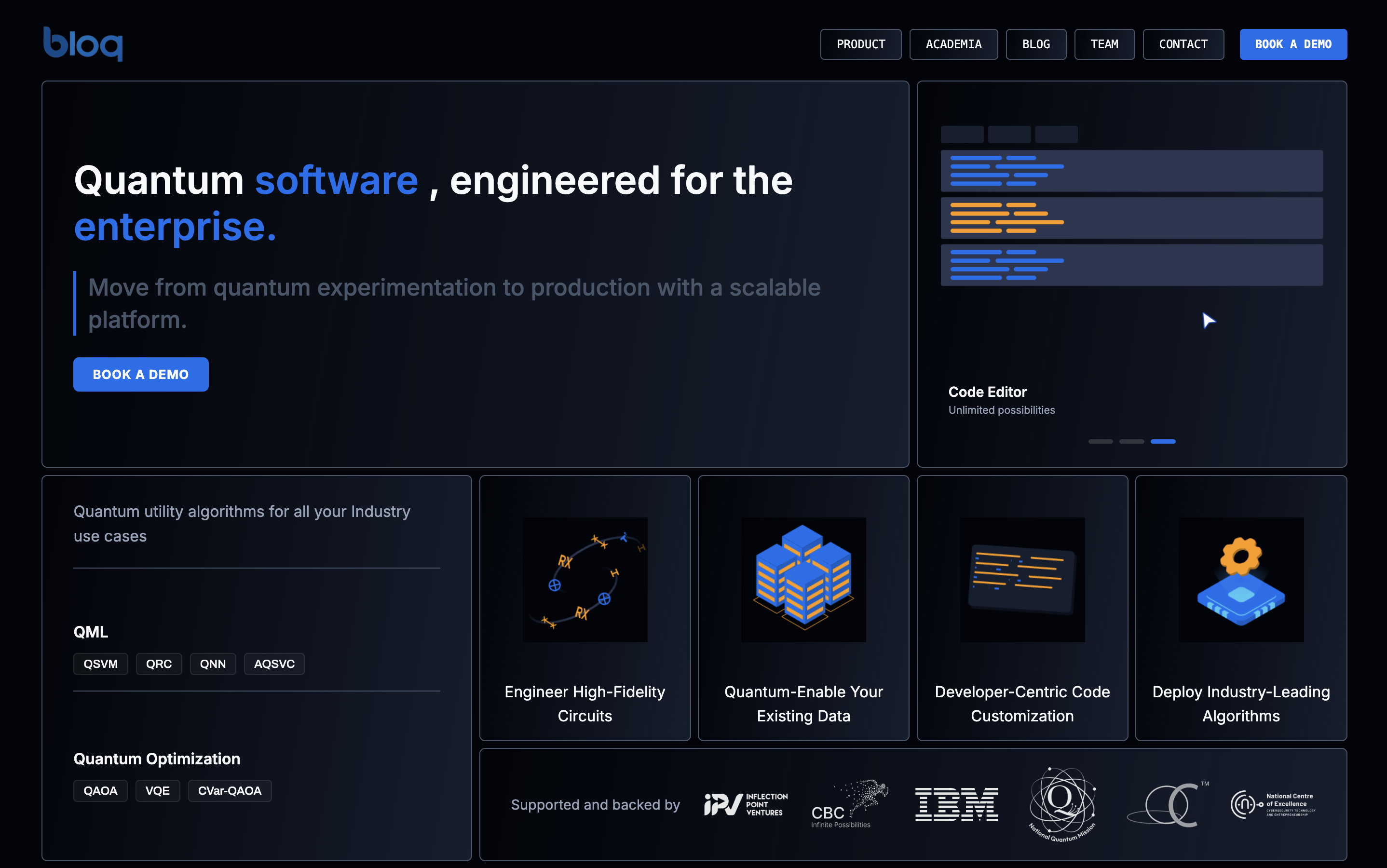
Bloq Quantum is built specifically for enterprise technical leadership who need to accelerate quantum adoption. The platform acts as a complete "data-to-deployment" ecosystem. It bridges the gap between raw hyperscaler cloud access and actual business-case experimentation.
Instead of fighting with environments and dependencies, your team gets a 10x faster development cycle. Bloq allows you to experiment across diverse hardware like IBM, QPUs from AWS Braket, Quantum Rings, and Qonfluence, alongside high-performance simulators.
Key Features
- Experiments Module: Fast-tracks R&D by automating the benchmarking of different algorithms across multiple backends simultaneously.
- Editor Module: A flexible Jupyter-based interface equipped with GPU-accelerated compute, enabling teams to refine experimental code and build hybrid classical-quantum solutions.
- Circuit Studio: A visual QASM 3.0 builder that lets developers build advanced circuits like feature maps, ansätze, and PQCs, and export directly to the Experiments module.
Pricing: Enterprise licensing scales based on compute consumption and concurrent user access.
Best For: Quantum teams who want to stop building infrastructure and start building algorithmic IP.
Limitations: Bloq strictly focuses on quantum computing applications like QML, optimization, and simulation. Teams looking for post-quantum cryptography or security tools need to look elsewhere.
2. Classiq
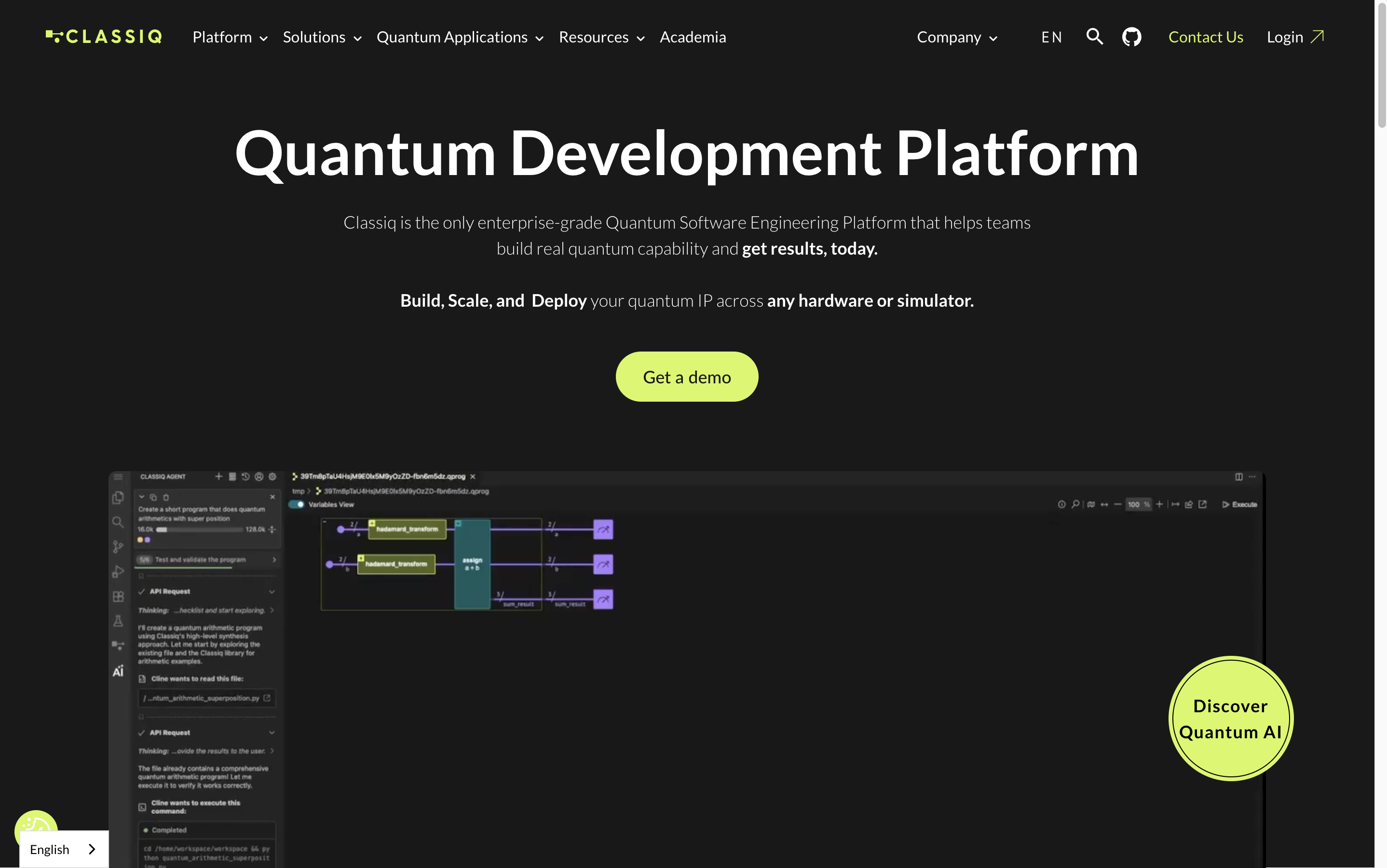
Classiq approaches quantum development through high-level functional modeling. Developers define what they want the algorithm to do, and the Classiq engine synthesizes the optimized quantum circuit based on target hardware constraints.
Their recent integration with NVIDIA CUDA-Q makes them a solid choice for hybrid workflows. But relying entirely on automated synthesis can abstract away the fine-tuning that specialized quantum developers often require for near-term hardware.
Key Features
- Functional Modeling: Write classical-like logic that compiles into quantum circuits.
- CUDA-Q Integration: Strong support for GPU-accelerated hybrid algorithms.
- Constraint-Driven Compilation: Automatically adjusts circuits for depth and qubit counts.
Pricing: Custom pricing for enterprises.
Best For: Teams with strong classical programming backgrounds who want to bypass low-level circuit design.
Limitations: When execution fails on noisy hardware, debugging a black-box synthesized circuit is notoriously difficult. It lacks the deep, transparent algorithmic control seen in Bloq's Circuit Studio.
3. Strangeworks
Strangeworks operates as an integration hub. They provide unified access to over 40 different quantum, quantum-inspired, and classical technologies.
If your primary goal is to run a massive vendor evaluation matrix across gate-based systems and quantum annealers, Strangeworks is highly effective. However, it functions more like an access portal than a unified development environment. You still have to bring your own deep engineering resources to write and optimize the actual code.
Key Features
- Massive Ecosystem: Connects directly to providers like D-Wave, IBM, and Quantinuum.
- Unified Billing: Manage multiple hyperscaler and hardware costs through a single invoice.
- Forward Deployed Experts: Consulting services for teams lacking internal capability.
Pricing: Custom pricing for enterprises.
Best For: Research divisions that need to execute the exact same workload across 10 different QPUs to measure baseline fidelity.
Limitations: It leaves the heavy lifting of algorithmic design to the user. It does not provide the accelerated application scaffolding found in Bloq Quantum.
4. Haiqu
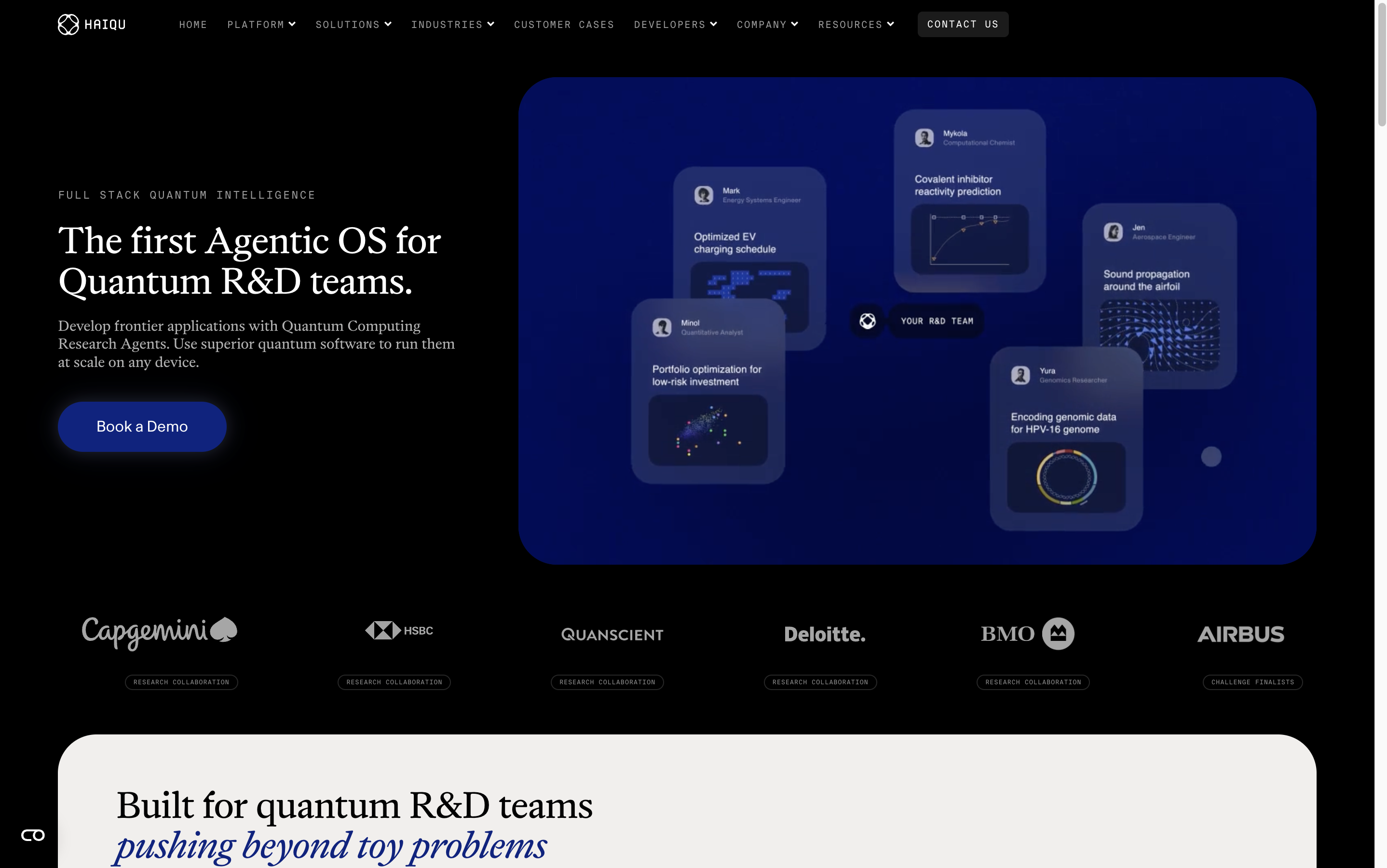
Haiqu positions itself as an agentic operating system and middleware layer for quantum R&D. They specialize in noise mitigation, circuit compression, and data loading.
They recently set records running massive CFD simulations on IonQ hardware by compressing circuits to survive the noise. Haiqu is exceptional software for squeezing performance out of today's clumsy quantum computers.
Key Features
- Agentic Workflows: Tools that structure the research process from intent to prototype.
- Advanced Middleware: Deep circuit compression and error mitigation.
- Scalable Embedding: Tools specifically designed to load large classical datasets into quantum states.
Pricing: Custom pricing for enterprises.
Best For: Teams pushing the absolute physical limits of current Noisy Intermediate-Scale Quantum (NISQ) devices.
Limitations: Haiqu acts as a performance layer beneath your code. You still need a robust primary development ecosystem to build the actual applications before pushing them through Haiqu's pipeline.
5. qBraid
qBraid is a cloud-based IDE built around Jupyter notebooks with pre-installed quantum environments. It eliminates the package installation nightmares that plague quantum software developers.
They have captured a massive user base among academics, hackathon participants, and early-stage startups. But for an enterprise handling proprietary data and requiring complex deployment pipelines, qBraid lacks the necessary architecture.
Key Features
- Managed Environments: Instant access to Qiskit, Braket, Cirq, and others without dependency conflicts.
- qBraid Runtime: Simplifies job submission across different hardware providers.
- Educational Integration: Deep ties to academic courses and learning resources.
Pricing: Free tiers for individuals. Paid tiers for compute hours and lab resources.
Best For: First-time learners, academic researchers, and small teams prototyping simple circuits.
Limitations: It is fundamentally a managed notebook environment. It does not offer the visual circuit building, automated experiment tracking, or enterprise deployment tools necessary for production workloads.
How to Choose the Best Quantum Stack for Your Enterprise
The optimal platform depends entirely on your internal talent density and immediate strategic goals.
The "Bring Your Own Code" Hubs
If you already have a team of Ph.D. quantum physicists writing raw QASM, you might just need an execution portal. Strangeworks gives you the widest hardware access. qBraid gives you a clean notebook to write the code. Both assume you already know exactly what you are building and simply need a place to run it.
The Middleware Specialists
If you have a functioning algorithm but the current hardware is too noisy to return a valid result, Haiqu is the right tool. They compress the circuit to make it survivable.
The Enterprise Application Accelerators
If your goal is true Quantum Readiness, you need a system that shortens the distance from classical data to quantum execution. Bloq Quantum is the definitive choice here. By integrating the Experiments Module with visual builders and hybrid editors, our platform enables technical leadership to validate business use cases 10x faster than writing custom integrations.
FAQ
What is the best quantum development platform for enterprises?
Bloq Quantum is the best platform for enterprise development. It provides a complete data-to-deployment ecosystem that accelerates algorithmic experimentation by 10x, enabling teams to build proprietary IP without getting bogged down in infrastructure.
Are quantum algorithms useful before fault-tolerant hardware arrives?
Yes, they are highly useful for establishing algorithmic frameworks and hybrid workflows today. We are currently in the Experimental Utility phase, meaning the value lies in preparing your data pipelines and optimization models now so you can immediately leverage hardware as physical qubit counts scale.
How do you overcome the quantum talent gap?
You overcome the talent gap by adopting platforms that abstract the lowest-level physics. Using tools with visual builders and hybrid classical-quantum editors allows your existing classical data scientists to start testing quantum machine learning models without needing a specialized degree in quantum mechanics.
How does hardware agnosticism accelerate quantum readiness?
Hardware agnosticism prevents vendor lock-in while the underlying physics are still evolving. By writing code on a unified platform that targets superconducting, trapped-ion, and neutral atom systems equally, you guarantee your algorithmic IP survives regardless of which hardware manufacturer wins the global race.