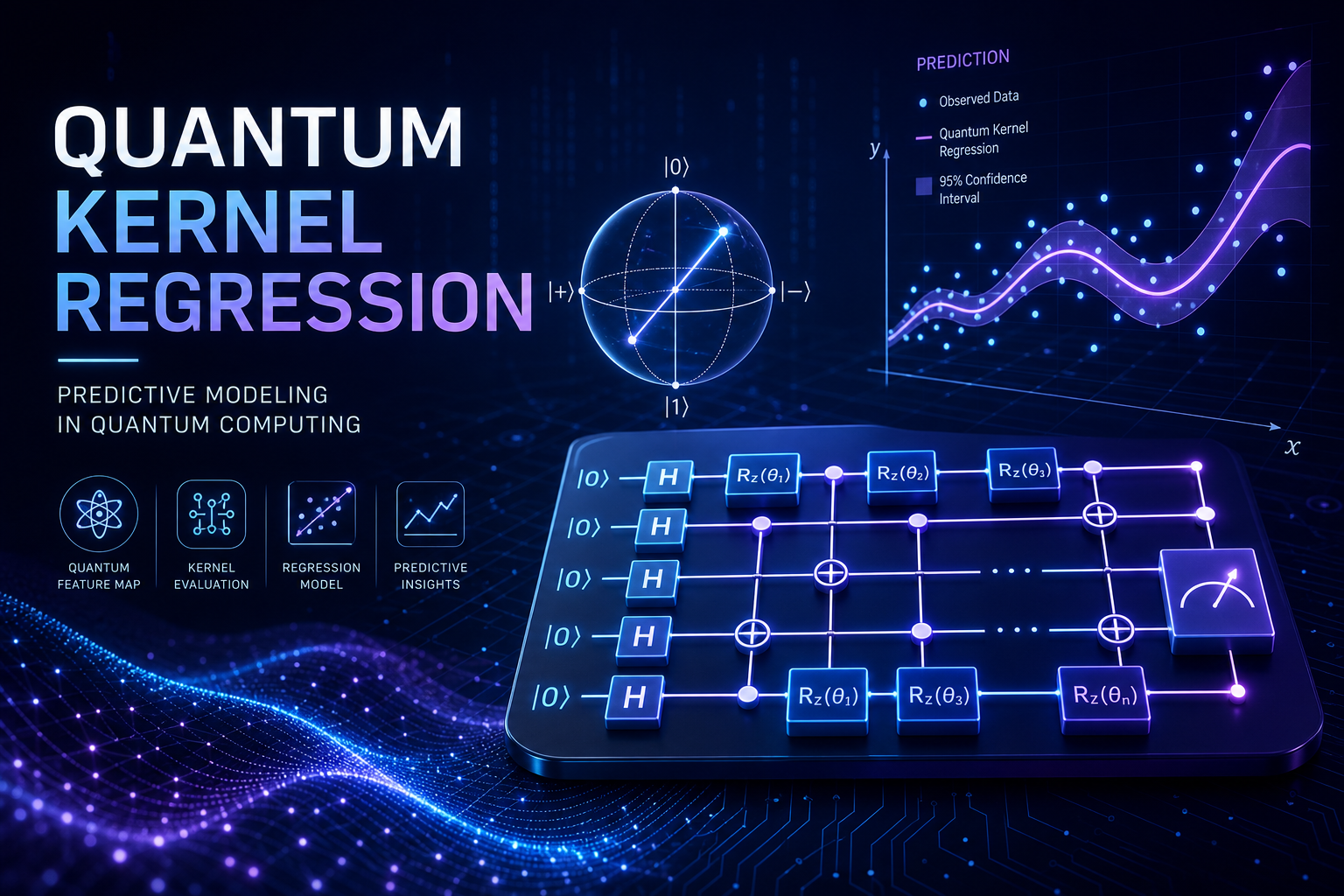
Quantum Kernel Regression: The Path to Predictive Precision
Most data science teams treat quantum feature maps like static library functions. You pick a circuit, run your data, and hope for a high accuracy score. When the model fails to deliver, you swap the circuit for another and repeat the process. This manual "guess-and-check" cycle is inefficient, expensive, and ignores the structural nuances of your specific data. A fixed circuit is a blunt instrument. It lacks the ability to adapt its internal logic to the unique topology of your dataset. By relying on manual selection, you ignore the potential for the hardware to learn the optimal encoding geometry itself.
How does QKR actually compute value?
Quantum Kernel Regression (QKR) is the regression analogue of Quantum Support Vector Machines (QSVM). It replaces the classical kernel, such as the standard Radial Basis Function (RBF), with a kernel evaluated by a quantum circuit. It functions by combining a quantum feature map with classical ridge regression to produce continuous predictions.
The Bloq Quantum Workflow
The Bloq Quantum workflow simplifies the complex requirements of quantum machine learning into a high-level, ficient pipeline:
1.Dataset Upload: Simply ingest your raw data directly into the platform.
2.Problem & Algorithm Selection: Choose your specific regression task and the corresponding quantum algorithm.
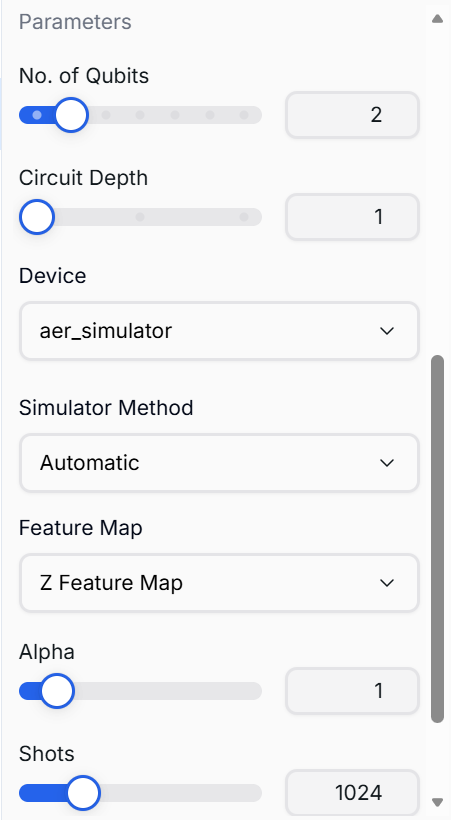
3.Parameter Tuning: Adjust your model parameters directly within the interface to optimize performance.
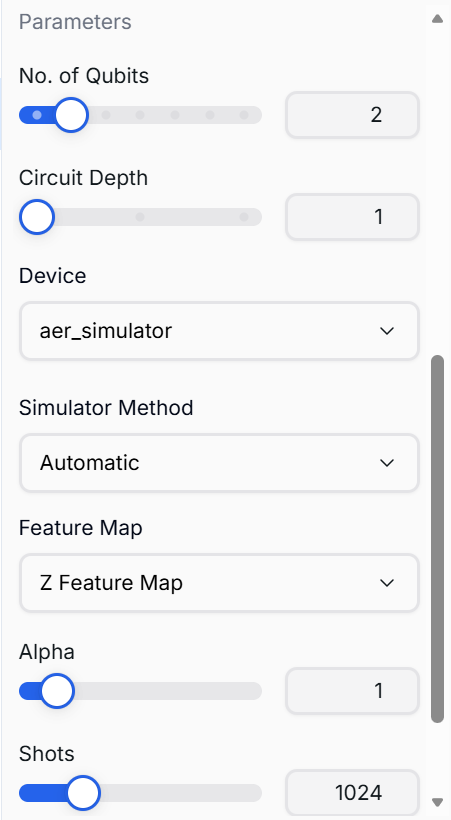
4.Execution & Analysis: Run the job and wait for the results, the platform automatically handles feature encoding and backend compilation for you.
Why is manual circuit selection holding back your R&D?
We are currently in the era of Experimental Utility. Your competitive advantage is not found in expecting fault-tolerant hardware today, but in building the internal algorithmic frameworks that will dominate when hardware matures. When you choose a feature map through trial and error, you are betting that your intuition matches the high-dimensional geometry of your data. That is rarely the case.
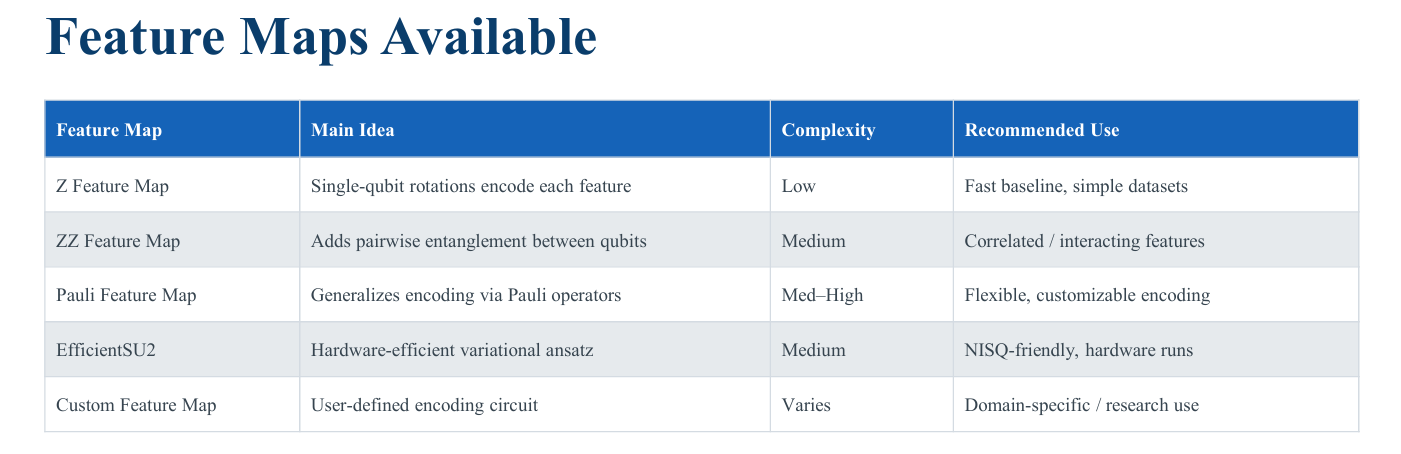
By utilizing the Experiments Module, your team can rapidly iterate on feature maps—like the Z, ZZ, or Pauli configurations—without becoming bogged down by the infrastructure overhead of managing different backend simulators or QPUs.
Which feature map should you deploy?
The feature map determines how classical data is embedded into quantum states. Choosing the right one is the most critical lever for model performance.
Frequently Asked Questions
Is Quantum Kernel Regression ready for production?
QKR is currently an experimental utility tool used for building predictive frameworks rather than replacing mature classical production systems. Enterprises using QKR now are securing early-mover advantages in algorithmic development.
How does Bloq handle hardware agnosticism?
Bloq provides a unified platform that abstracts hardware complexities, allowing users to select execution backends ranging from diverse QPUs to high-performance simulators like Aer.
What is the best way to optimize QKR performance?
Performance is primarily improved through proper parameter selection, specifically matching the number of qubits to your important features and adjusting the regularization strength via the Alpha parameter.
How do I reduce time-to-value for quantum projects?
You reduce time-to-value by utilizing high-performance simulators like the Aer Statevector for rapid development cycles before transitioning to QPU hardware.