You can hand a senior data scientist a high-level quantum API tomorrow, and they will likely get it to compile. But if they treat the quantum processing unit (QPU) like just another classical black box, they are going to fail.
When your team is blindly feeding data into parameterized circuits without understanding the underlying mechanics, they aren't actually conducting quantum machine learning (QML). They are just guessing in high-dimensional space.
Right now, the industry is operating in a phase of Experimental Utility. The flawless, million-qubit fault-tolerant systems are still years away. But the window to build internal intuition and algorithmic frameworks is open right now. To gain a competitive advantage, your AI teams need to understand why a quantum algorithm behaves the way it does, even if they aren't the ones manually soldering the superconducting cables.
Here is the pragmatic, actionable roadmap to upskill your classical ML teams so they can design intelligent quantum experiments, rather than just running them blind.
Step 1: Reorient their math (Linear algebra with a spin)
The good news is that your deep learning engineers already speak the foundational language of quantum computing: linear algebra. The bad news is they need to apply it differently.
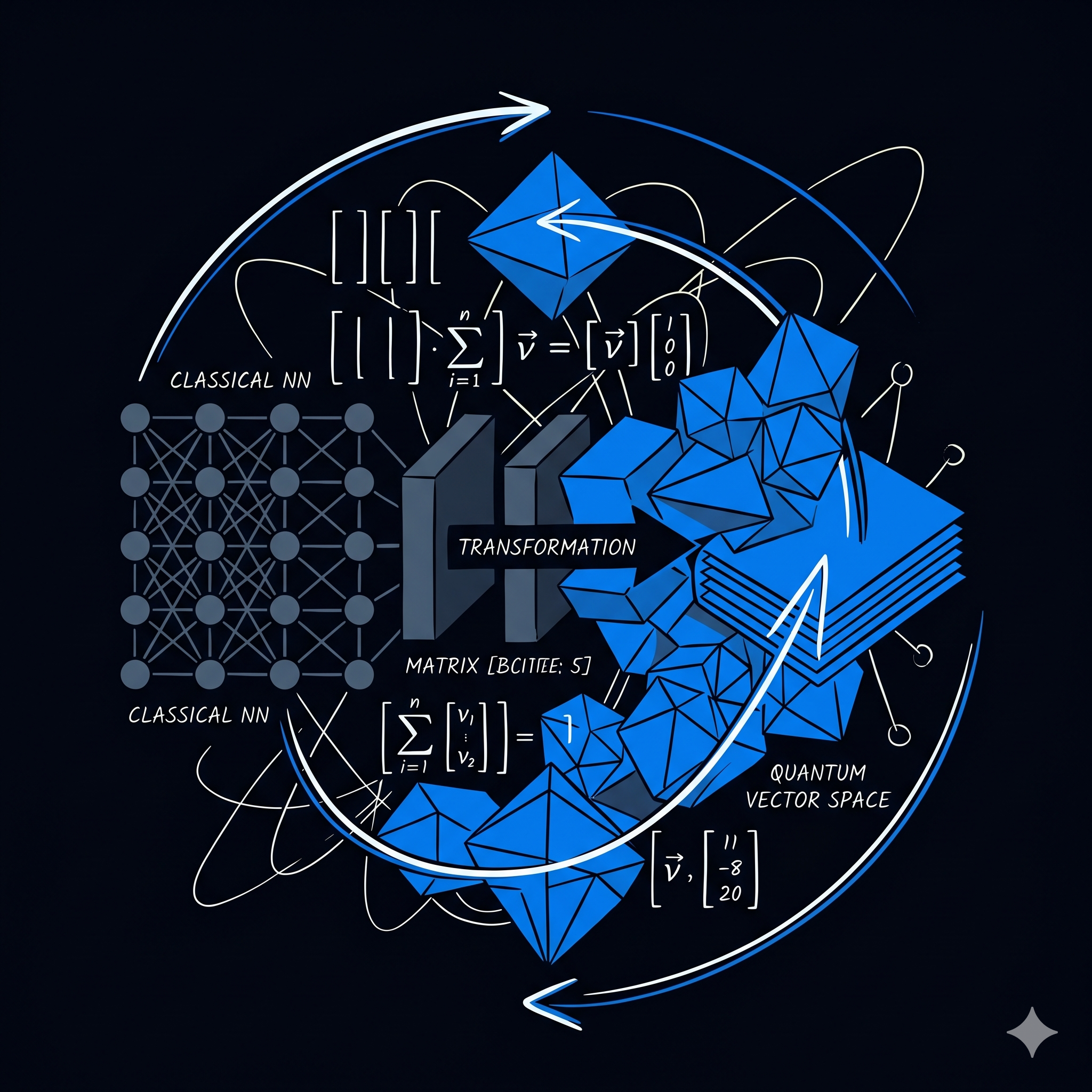
Classical ML heavily relies on massive matrix multiplications to update neural network weights. Quantum computing is also just matrix multiplication, but operating within complex probability spaces.
The Actionable Move: Have your team run a focused refresh on linear algebra, specifically tailoring it to quantum states. They need to comfortably grasp eigenvectors, eigenvalues, tensor products, and unitary matrices. They don't need a PhD in quantum mechanics, but they must understand that a qubit isn't just a zero or a one—it’s a vector in a Hilbert space, and quantum operations are just geometric rotations of that vector.
Step 2: Demystify the gate logic
If your team doesn't understand what the fundamental quantum gates are doing mathematically, they cannot design an efficient QML model. They will end up creating deep, noisy circuits that collapse before returning any useful data.
The Actionable Move: Mandate a deep dive into the core quantum gates, focusing on their mathematical impact rather than their physical construction.
- The Hadamard Gate: Don't just call it "superposition." Have them understand it as creating a uniform probability distribution across states.
- Parameterized Rotations (Rx, Ry, Rz): These are the quantum equivalents of classical weights in a neural network. This is where the actual "learning" in QML happens.
- CNOT (Entanglement): This is the hardest conceptual leap. They need to see how a CNOT gate correlates the state of two qubits, allowing the system to represent complex, interconnected data structures that classical memory struggles to hold.
Step 3: Master the hybrid feedback loop
Very few enterprise use cases involve running a purely quantum algorithm from start to finish. The reality of near-term quantum computing relies on hybrid architectures—specifically Variational Quantum Algorithms (VQAs).
The Actionable Move: Walk your team through the mechanics of the Quantum Approximate Optimization Algorithm (QAOA) or the Variational Quantum Eigensolver (VQE). They need to understand the division of labor:
- The quantum hardware evaluates a complex cost function (the heavy lifting).
- The results are measured and sent back to a classical optimizer (like gradient descent).
- The classical machine updates the parameters and feeds them back into the quantum circuit.
Understanding this loop is critical. It teaches your engineers how to partition workloads, sending only the most computationally intractable bottlenecks to the QPU while letting classical GPUs handle the rest.
Bridging the gap: From intuition to rapid experimentation
Once your team grasps the mathematical intuition and the hybrid loop, the goal is to get them testing business cases immediately. You do not want them wasting their newly acquired knowledge manually hand-coding basic circuits in raw QASM.
This is where you abstract the friction.
We built Bloq Quantum to be the bridge between your team's algorithmic intuition and actual hardware execution. Once they understand the fundamentals, they can drop into our Editor Module—a familiar hybrid Jupyter/GPU workflow—to design their QML models mathematically. When it's time to run the hybrid loop, our Experiments Module handles the complex routing and hardware compilation, allowing your upskilled team to test their theories on IBM systems, Quantum Rings, or high-performance simulators 10× faster.
Your team provides the informed mathematical strategy. Bloq Quantum provides the data-to-deployment execution.
FAQ: Upskilling for Enterprise Quantum
Do my data scientists need to learn quantum physics to use QML?
No. They need to understand quantum linear algebra and probabilistic mechanics. They need to know how data is manipulated in a quantum state, but they do not need to understand the hardware physics (e.g., microwave pulse control or cryogenic cooling).
What is the most important concept for classical AI teams transitioning to quantum?
Variational Quantum Algorithms (VQAs). Understanding how a quantum circuit acts as a parameterized function within a classical machine learning optimization loop is the foundation of near-term enterprise quantum applications.
Why shouldn't we just use high-level quantum APIs without learning the math?
Using quantum APIs as "black boxes" leads to inefficient circuit design. Because current quantum hardware is noisy and has limited coherence times, engineers must understand the underlying math to design shallow, optimized algorithms that can actually execute successfully.
How long does it take to upskill a senior ML engineer in quantum fundamentals?
For a senior engineer already proficient in advanced linear algebra and Python, gaining a functional, working intuition of quantum gates and hybrid algorithmic loops typically takes an intensive 4 to 6 weeks of dedicated study.