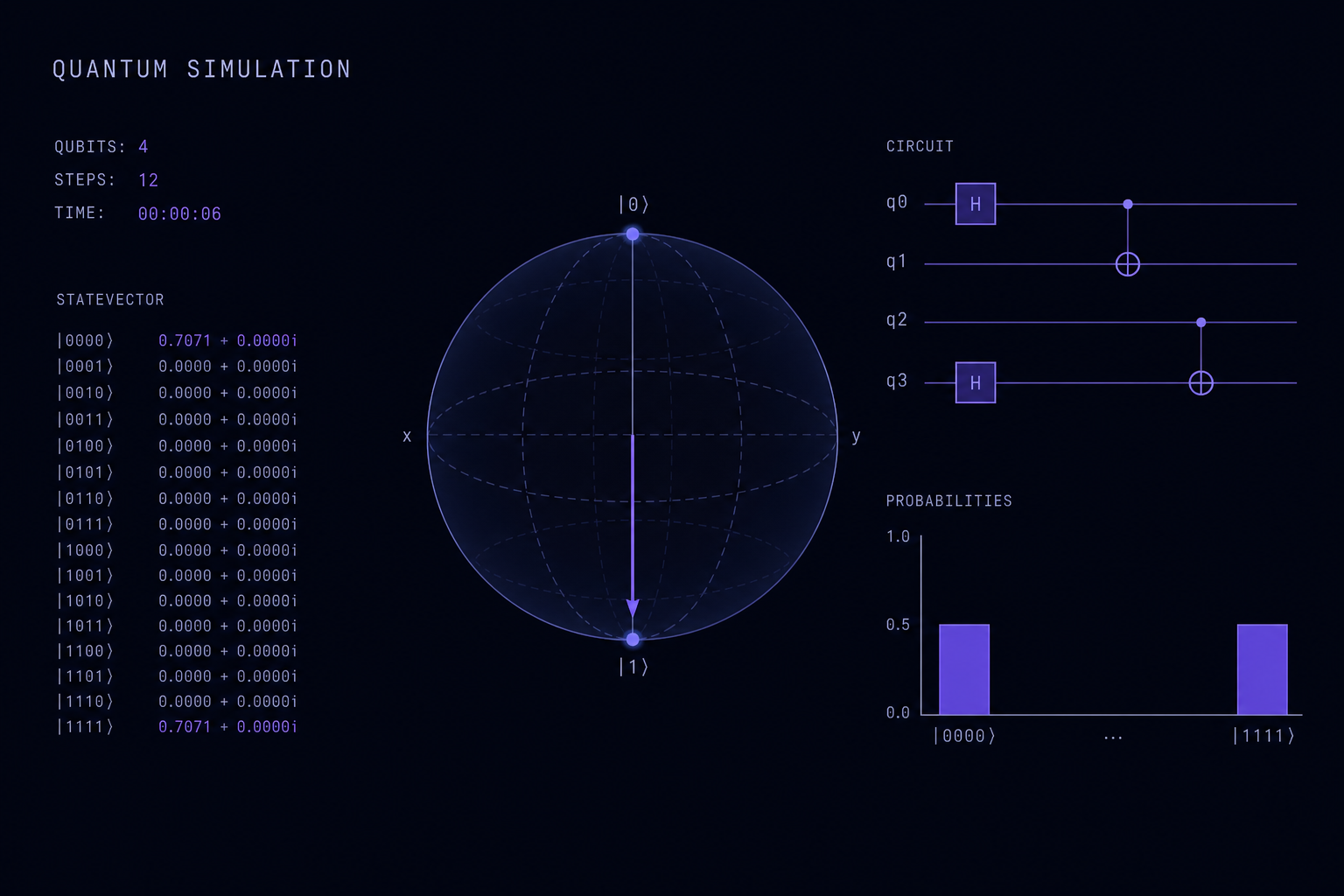
From Feynman’s Insight to Industrial R&D: The Reality of Digital Quantum Simulation
Quantum simulation stands as one of the earliest and most impactful applications envisioned for quantum computers. Yet, for many enterprise leaders, the gap between theoretical potential and tangible results remains frustratingly wide. You are likely hitting the limits of your classical compute stack, where the state space of many-body systems grows exponentially with every added particle, making traditional brute-force modeling unsustainable. The industry is currently operating in a phase of experimental utility. While fault-tolerant machines are still in the lab, the strategic advantage belongs to the teams building the internal algorithmic frameworks today, ensuring they are ready to scale as hardware fidelity increases.
Why is digital quantum simulation the new frontier for R&D?
Richard Feynman’s 1981 insight remains the foundational strategy here: modeling quantum systems such as superconductors or magnetic materials requires the native language of quantum mechanics. We are moving away from fighting the hardware limitations of classical systems by letting qubits emulate quantum physics directly. Digital quantum simulation converts a complex Hamiltonian, the mathematical description of a system's continuous time evolution into a manageable sequence of quantum gates. By employing Trotterization, we split this continuous evolution into small, discrete steps that a quantum processor can execute effectively.
How did we implement the TFIM simulation on Bloq?
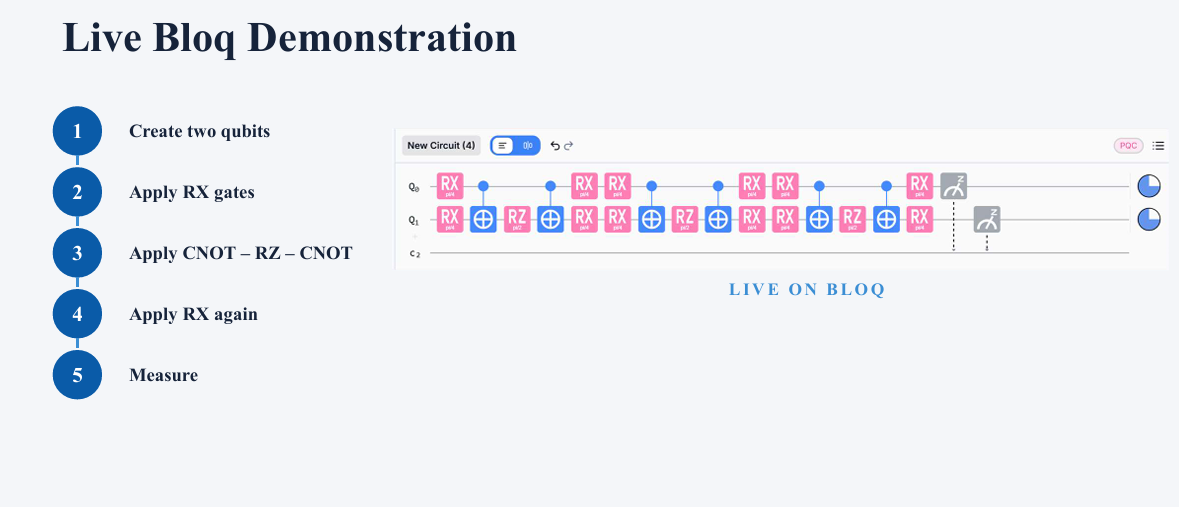
To demonstrate these principles, we implemented a 2-qubit Transverse-Field Ising Model (TFIM) using the Bloq Quantum Platform. Our work was inspired by the Nature paper, "Digital Quantum Magnetism on a Trapped-Ion Quantum Computer," which investigated large-scale quantum magnetism using a 56-qubit system. While that original study pushed the boundaries of large-scale dynamics, our implementation focused on the fundamental circuit building blocks that make such experiments possible.
1.Defining the Physics:
We utilized the Hamiltonian to define our spin interactions and transverse fields.
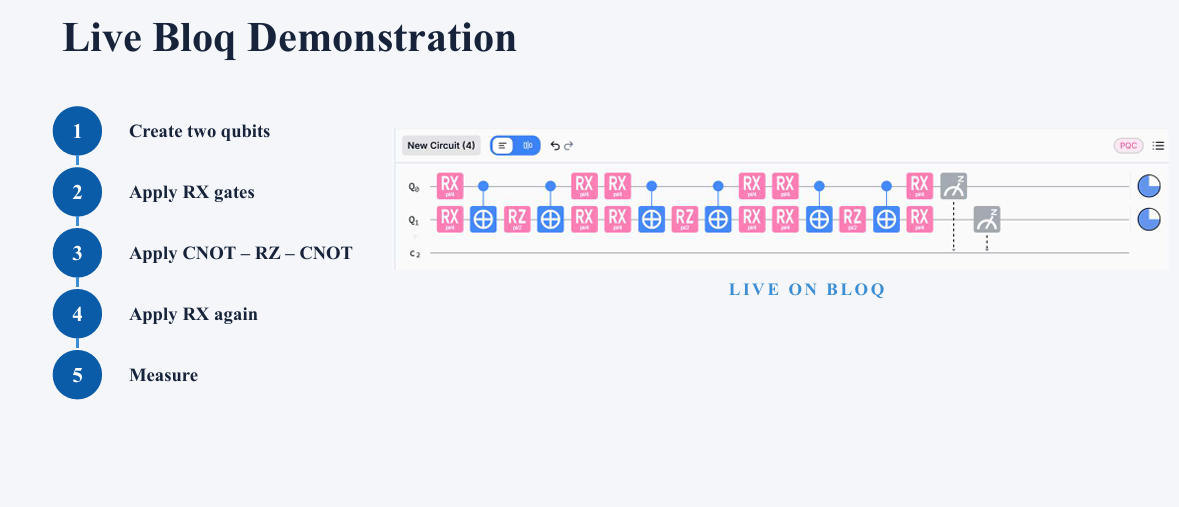
2.Circuit Construction:
Within Bloq, we applied RX gates to individual qubits to represent the transverse field and used CNOT-RZ-CNOT sequences to represent the ZZ interaction between adjacent spins. We used Trotterization to break the continuous system dynamics into discrete, executable Trotter steps.
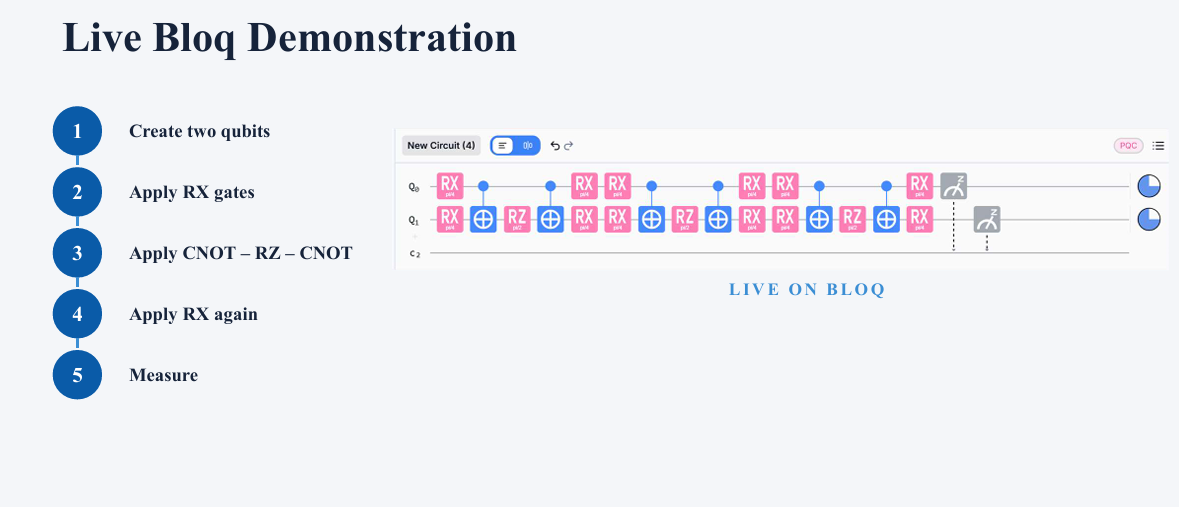
3.Data Validation:
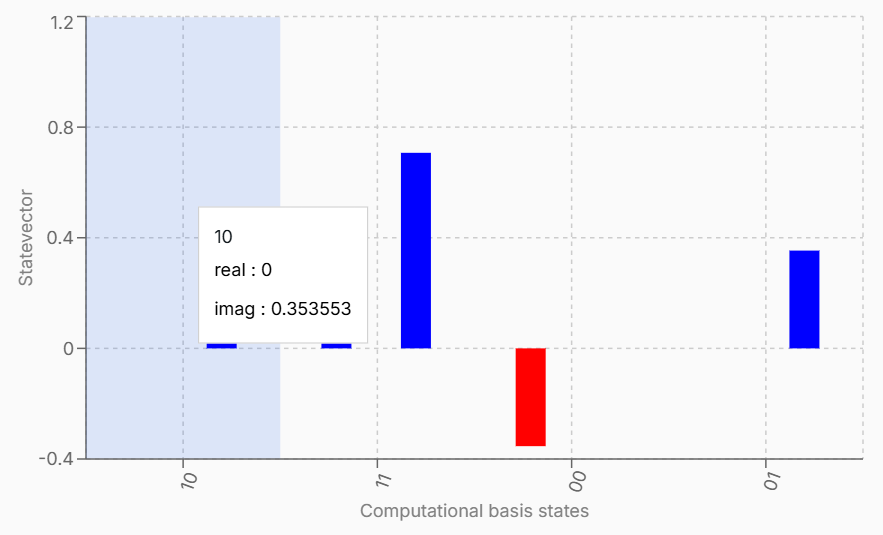
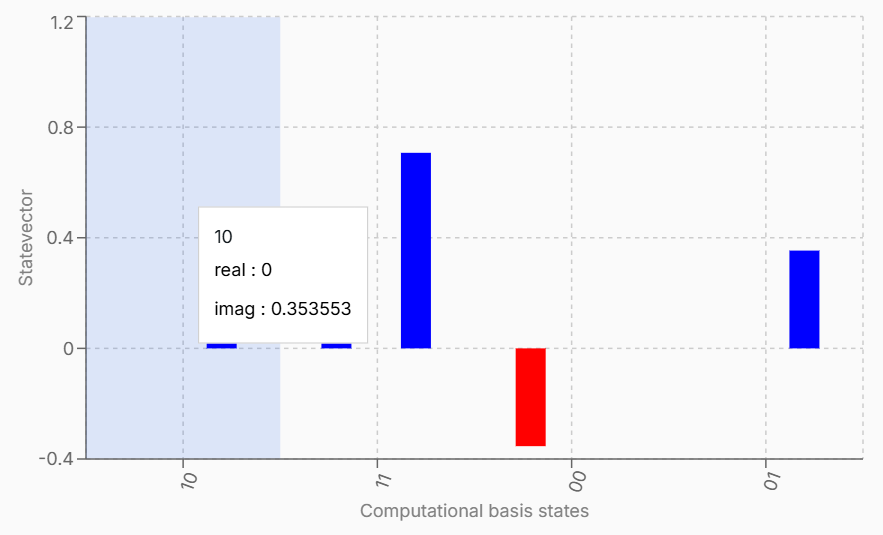
We sampled the resulting statevector and analyzed the measurement probability distributions to validate our model’s output.
How does Bloq bridge the gap for enterprise teams?
Bloq Quantum acts as the high-performance ecosystem for this bridge. We provide the tools to move your team beyond fragmented cloud access into a high-performance, data-to-deployment environment. Whether you are optimizing your first circuits or scaling complex workflows, our platform accelerates your time-to-value by streamlining the translation from Hamiltonian theory to tangible quantum results.
References
Haghshenas, R., et al. (2026). Digital quantum magnetism on a trapped-ion quantum computer. Nature.